
How to ·
Kamayan: How to Eat Filipino Food With Your Hands
Kamayan is eating Filipino food with your hands: fingertips only, rice pressed and pushed with the thumb. The technique, the manners and where to try it in Dubai.
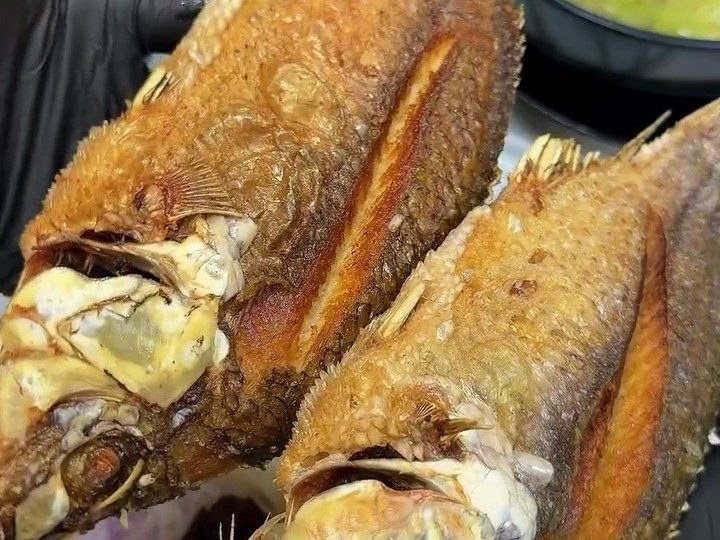
Kamayan means eating with your hands, from the root kamay, hand. It is not a novelty or a themed night. It is how most Filipino food was eaten before cutlery arrived with colonisers, and it is still how families eat at home when nobody is performing for guests. The technique takes about two minutes to learn and changes how the food tastes, because your fingers tell you the temperature and the texture before your mouth does.
The technique, in four moves
- Wash first, at the table if there is a bowl, at the sink if there is not. Clean hands are the whole social contract of kamayan.
- Use the fingertips of one hand only, never the palm. The right hand does the eating in most families.
- Press a small amount of rice into a loose ball with your fingers, top it with a piece of the ulam, then push the whole thing into your mouth with your thumb.
- Do not lick your fingers between mouthfuls, and do not reach past the food in front of you. Both are read the same way anywhere in the world.
Why rice is the tool
Filipino food is built around rice in a way that makes hands practical rather than messy. Sauce goes on the rice, the rice takes the shape you press it into, and the ball you make carries the sauce to your mouth without a drop landing on the table. Try it with a dry dish and it feels awkward. Try it with a stew and it makes immediate sense, which is why kamayan and saucy food evolved together.
The dishes this technique was made for
Anything crisp, anything on the bone, and anything you would otherwise chase around a plate with a fork. These four are where the hands earn their place, and every one of them is on the menu today.
Table manners nobody explains out loud
- Elders and guests are served first, and in many families they take the first mouthful before anyone else starts.
- The person who cooked will keep insisting there is more food. Say kain pa, eat more, back to them and everyone is happy.
- Leaving a little rice is not rude, but leaving the last piece of meat untouched for hours is: it becomes the hiya piece nobody dares to take.
- If you are unsure, copy the person next to you. Nobody at a Filipino table has ever been offended by a beginner trying.
Where to try kamayan in Dubai
The full version of this is the boodle fight, where the leaves go down the middle of the table and the plates disappear entirely. It is the same etiquette at a bigger scale, and it is the easiest way to eat this way for the first time without feeling watched.
For thirty people or more the same format moves to your venue, and catering starts at AED 49 per head. No pork is served at Pinoy Tambayan. That is worth knowing before you plan a table for a mixed group.
If you are left-handed
Use your left. The right-hand convention comes from the practical business of keeping one hand clean for serving and passing, not from a rule about which hand is correct, and no Filipino table is going to correct a left-handed guest. What matters is that one hand does the eating and the other stays out of the food.
Kamayan with children
Children take to it faster than adults, because they have not yet learned that hands are supposed to be wrong. Give them a smaller section of the leaf, keep the sauce dishes on your side of the table, and let them press their own rice balls. It is the same reason Filipino families teach it early: eating with your hands is how a child learns the temperature and texture of food before anyone tells them what it is called.
Why cutlery arrived late
Spoons and forks came to the Philippines with Spanish colonisation, and the fork never really won. A Filipino table today still runs on a spoon and fork rather than a knife, because the food is cooked to the point where a spoon is enough. Kamayan survived alongside them for the same reason: for rice, sauce and anything on the bone, hands are simply better tools, and every family knows it even where the cutlery is on the table. If this is your first Filipino meal, what to actually order is covered in our first timer's guide.
Kamayan questions we get asked
What does kamayan mean?
It comes from kamay, the Filipino word for hand. Kamayan is eating with your hands, fingertips only, with rice as the tool that carries the sauce.
Is it rude to ask for cutlery?
Not at all. Cutlery is on the table and nobody is judged for using it. Kamayan is an invitation rather than a rule.
Do you provide somewhere to wash?
Yes. Water and soap come to the table before the food, which is the first step of kamayan everywhere it is eaten.
Which hand should I eat with?
The right hand in most families, and one hand only. The other stays clean for serving, drinking and passing dishes.
Can I book a kamayan table for a group?
Yes. Message us with the number of people and the time, and the kitchen builds it fresh for when you arrive.
We are opposite Dubai International Academy in Al Barsha 1 and we are open 8:00 AM to 1:00 AM every day, rated 4.5 on Google. Come hungry, wash your hands, and let somebody's tita show you how it is done.
Straight from our Google reviews
“The food are amazing as a matter fact I forced them to cater their food on my birthday recently and as expected, everything is great and all my visitors were asking about them.”
“If you are looking for food that tastes like home cooked meals come to Pinoy Tambayan Restaurant. The food tastes delicious for an affordable price. Maria provides an outstanding customer service, making you feel at home.”
Copied word for word. Read all 558 five-star reviews
More from the Dining Guide
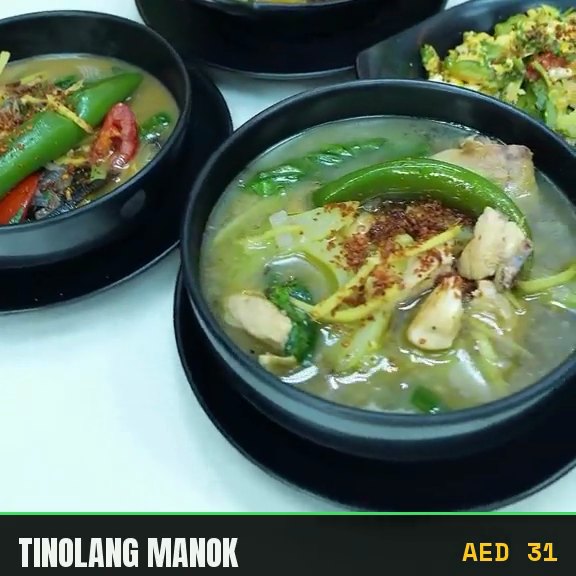 Tinolang Manok: Filipino Ginger Chicken SoupTinolang manok is chicken simmered in a clear broth built on ginger, garlic and onion, with a green vegetable and leaves added at the end. It is AED 31 at Pinoy Tambayan, the cheapest of the nine soup rows on the menu, and the dish Filipino households cook when somebody is unwell.
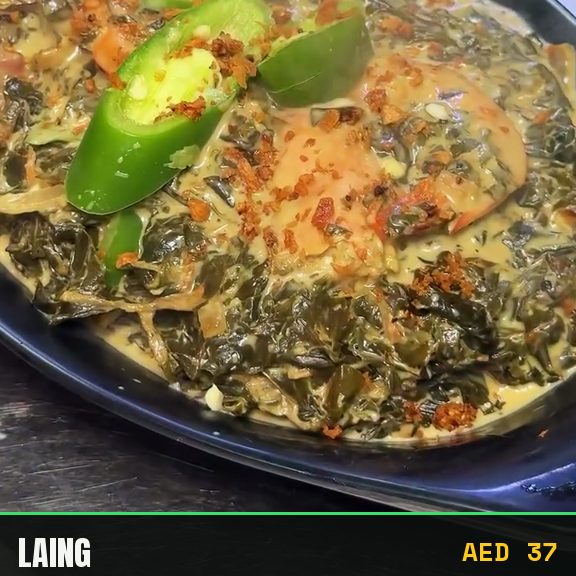 Laing: The Filipino Taro Leaf Dish From BicolLaing is dried taro leaves simmered in coconut milk with chilli and ginger until the sauce thickens, a Bicol dish that costs AED 37 at Pinoy Tambayan. It is one of nine vegetable rows on the menu and one of the few named by diners in their own reviews.
 Filipino Desserts at Pinoy Tambayan: Ube Halaya to Leche FlanPinoy Tambayan keeps six desserts on the printed menu at Al Barsha, from a five-dirham ice cream cone to a nineteen-dirham leche flan, plus halo halo as a seventh on its own guide. Every price and dish name below comes straight off the menu, not a guess.
Hungry now?
Open daily, 8:00 AM to 1:00 AM. No pork is served at Pinoy Tambayan. Free delivery within 5 km, AED 5 beyond, and no minimum order.
Book a kamayan table on WhatsApp +971 4 328 2669 Book a table Get directions